Why Old Office Carpet Stains Reappear After Cleaning
The coffee ring beside the printer was gone on Monday morning. By Thursday it had come back, in almost exactly the same place, and nobody had spilled anything in between. The invoice for the clean has already been approved, which makes the whole thing look like money spent on nothing.
Most of the time the clean did work. What you are seeing is a second process that begins after the machine leaves the floor, and once you understand it, the conversation with your provider changes completely.
Why does a stain come back after the carpet has been cleaned?
A stain that reappears within a few days is usually wicking. Liquid that soaked past the pile into the backing or the underlay travels back up the fibres as the carpet dries, carrying old soiling with it and leaving it at the surface where you can see it again.
The original spill was never limited to the tufts on top. A tipped cup on a busy walkway spreads sideways and downwards, and a surface clean lifts only the portion sitting in the upper few millimetres of pile. Everything below stays where it is until drying pulls moisture upward and the residue rides along. That is why a wicked stain often has a soft, feathered edge and covers slightly more ground than the mark you remember reporting.
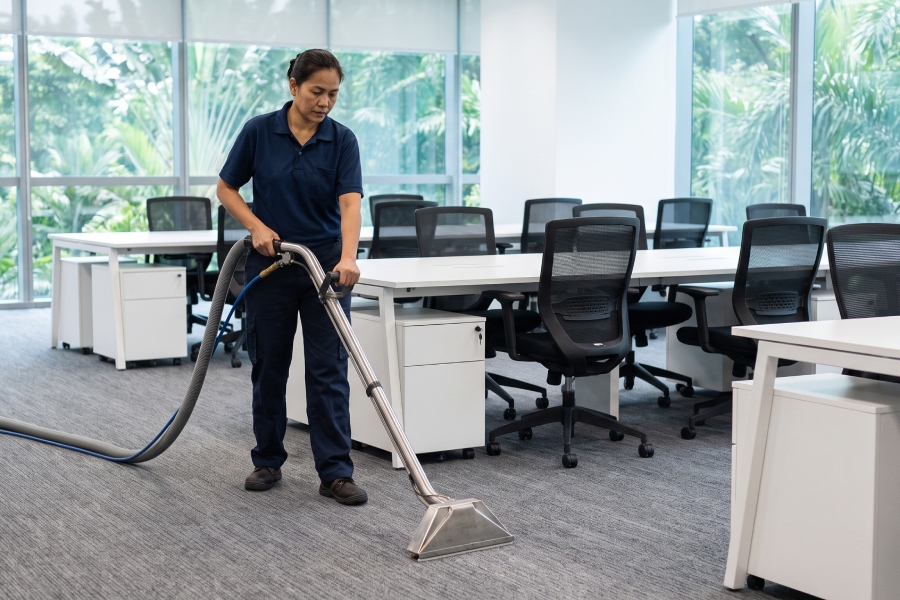
This is also why professional carpet cleaning uses slow extraction passes and controlled moisture instead of simply wetting the affected patch. The aim is to pull contamination out of the carpet rather than push it deeper and wait for physics to send it back up.
Wicking and re-soiling are two different faults
Wicking brings old contamination up from below. Re-soiling is fresh dirt clinging to detergent residue left behind in the pile, and the two behave differently enough that you can tell them apart without any equipment.
Re-soiling appears as a general greying along a traffic lane instead of a defined mark returning in one spot, and it builds over a fortnight rather than showing up within days. Detergent residue is slightly tacky, so every shoe crossing it deposits more than it would on properly rinsed fibre. A whole corridor dulling after a visit points to an inadequate rinse. One mark coming back in one location points to liquid that went deeper than the extraction reached.
Singapore’s humidity keeps the moisture moving for longer
Slow drying gives wicking more time to work. With a mean annual relative humidity of around 82 per cent, carpet in a Singapore office holds residual moisture noticeably longer than the same carpet would in a drier climate.
Airflow does more here than temperature. A closed meeting room with the door shut and the air conditioning off from seven in the evening will still feel cool and damp underfoot the next morning, while an open-plan floor with fans running dries in a fraction of that time. The rooms that generate repeat complaints are almost always the ones nobody opens overnight.
Fibre type changes the timing too. Wool and synthetic carpets hold and release water at different rates, so the material under your desks affects how long the risk window stays open after every clean.
What to check before you call it a failed clean
Two minutes of observation will usually tell you which problem you have, and that decides what you ask your provider for. Look at four things.
- Shape and position – A defined patch returning in the same spot suggests wicking, while a broad dull band along a walkway suggests residue.
- Timing – Anything appearing one to three days after the clean is drying related. Anything appearing a fortnight later is re-soiling.
- What was originally spilled – Sugary drinks, soup, milk and anything oily travel deep and come back most often.
- What sits underneath – Carpet laid over a raised access floor behaves differently from carpet tiles bonded to screed, particularly where an old spill soaked into the substrate.
Photograph the area under the same lighting each time. A phone picture taken from the same angle a week apart settles most disagreements about whether a mark is returning or simply spreading.
How to stop the same mark coming back
Deeper extraction and faster drying resolve the majority of repeat marks. A technician who suspects wicking will usually re-treat the area, extract with additional dry passes to pull as much moisture as possible out of the backing, then set up airflow so the carpet dries in hours instead of overnight.
Weighting the spot helps in stubborn cases. A folded white towel pressed under a weight on the damp patch absorbs the rising moisture as the carpet dries, so the residue transfers into the towel instead of surfacing in the pile. It is a slow method and it looks unglamorous in an office, but it works on the marks that have already returned twice.
The longer-term fix is dealing with the spill properly on the day it happens. Blotting immediately, resisting the temptation to soak the area with water, and flagging anything sugary or oily to your cleaning team means far less material ends up in the backing waiting for its chance to rise.
Conclusion
A mark that keeps returning is telling you something specific about how deep the original spill went and how slowly that section of your floor dries. Both are fixable once someone looks at the actual floor instead of the invoice.
If a patch in your office has come back more than once, we are happy to take a look. Get in touch with Lukis at info@lukisclean.com or call us on +65 6741 9968, and we can arrange a site visit to assess the affected area and talk the options through with you.