Year-End Office Deep Clean: What To Book Before December
The office reopens on the first working day of January and something is off. The pantry smells faintly of whatever was left in a bin on Christmas Eve, and the meeting room carpet has kept the mark from the department lunch.
Most Singapore offices close for a few days at the end of December, and that shutdown is the only stretch of the year when a deep clean can happen without staff working around it. Every other office manager has worked that out too. By the second week of December, the useful slots have gone.
Why does December book out so early?
Cleaning providers have a fixed number of teams and a shrinking number of working days, so demand outruns supply well before the month starts. The compression is easy to see in the calendar. Christmas Day 2026 falls on a Friday and New Year’s Day 2027 falls on a Friday as well. An office that gives staff the Monday to Thursday in between ends up closed from 26 December to 3 January, which is the same nine-day window every other office is eyeing.
There is a cost dimension too. Employees required to work on a gazetted public holiday are entitled to an extra day’s salary at the basic rate of pay under the Employment Act, as set out in MOM’s guidance on public holiday entitlements and pay. A team asked to work on 25 December or 1 January will therefore be quoted differently from one working an ordinary Saturday. Booking the weekend either side of the holiday usually costs less and gets you a fuller crew.
When should you book a year-end deep clean?
Book by the first week of November if you want the last week of December. Mid-November is usually still enough for a slot in the first week of January, when demand tails off and providers have more flexibility on crew size.
Booking early has a second advantage. A November confirmation means someone can come and look at the office while it is still occupied and behaving normally, which produces a far more accurate scope than a walkthrough of an empty floor on the day itself.
If your office runs an annual scope review, tie the deep clean to it. A provider quoting for professional office cleaning in the new year can usually fold the year-end deep clean into the same site visit, which saves you explaining the floor plan twice.
What should a year-end deep clean actually cover?
A year-end deep clean goes after the build-up that daily cleaning is not scoped to reach. Ask your provider to quote specifically for:
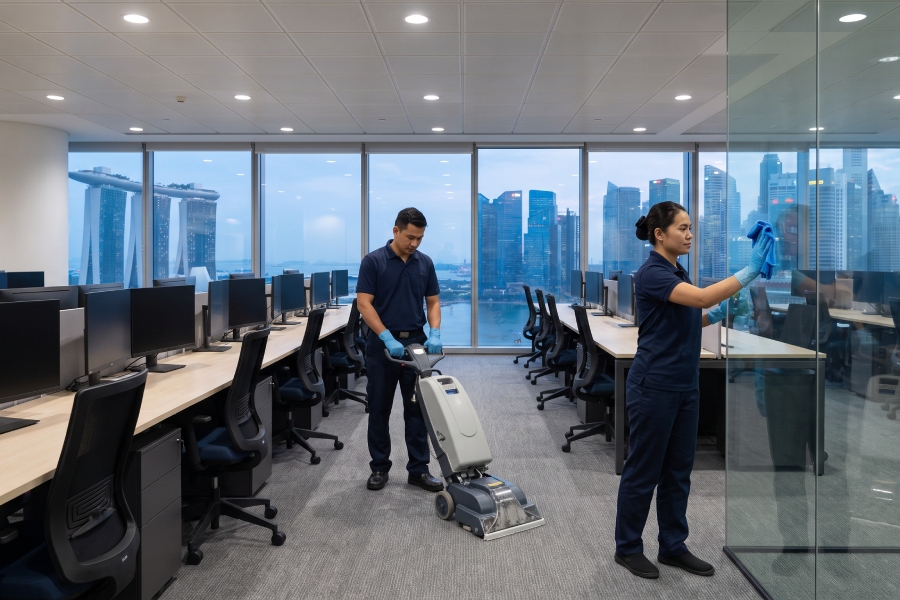
- Carpet extraction across meeting rooms and open-plan floors, not spot treatment
- Full pantry strip-down, including behind and beneath the fridge, the microwave, and the cabinetry
- Washroom descaling, floor grout, and cubicle partitions
- Upholstery cleaning for reception seating and fabric task chairs
- Interior glass, partitions, and the tops of cabinets, ledges, and skirting
- Vent covers and light diffusers wiped down as surfaces, along with high-level dusting
High-traffic office areas repay this work best, since a lobby floor or a shared pantry accumulates more in a quarter than a quiet corner office does in a year.
Carpets set the timetable
Carpet is the item that decides your booking date, because it needs drying time before the office is usable again. Hot water extraction in Singapore’s humidity takes several hours to dry with air movers running, and longer if the air conditioning is off over the shutdown, which it usually is.
Plan the carpet work for the front of your closure window instead of the last day. If the office reopens on a Monday and the carpets are done on the Sunday, you are gambling on the weather. Booking office carpet cleaning for the first available day of the shutdown gives the fibres time to dry properly and gives you room to raise anything that was missed.
Ask the provider what drying support they bring and whether building management will let the air conditioning run during the closure. That second question often decides how the day goes.
What to sort out with building management first
Deep cleaning during a shutdown depends on access, and access is controlled by the building. Most Grade-A and multi-tenant buildings in Singapore require after-hours work permits, lift bookings for equipment, and named security clearance for everyone entering, and these applications close earlier in December than in an ordinary month. Waste is the other one to check early, because a full clear-out generates bags with nowhere to go if the building’s refuse collection pauses over the holiday.
A short list to confirm before you sign off
Before the booking is final, confirm:
1. The exact dates and start times, including whether the crew is working a public holiday
2. Who holds the access permits, and by when the building needs the names
3. Whether carpet drying equipment is included or quoted separately
4. Who from your side is on site or reachable for the walkthrough at the end
That last one gets skipped more than any other. A walkthrough on the day, with someone who knows what the office normally looks like, is the difference between a snag list you can act on and a complaint raised three weeks later when nothing can be verified.
Book the days you have
December is short, and the useful part of it is shorter. If your office closes over the year-end period and you want the space to feel properly reset when everyone returns, now is the time to have that conversation. Talk to us at Lukis about a site visit, and we will walk your floor with you and put together a scope that fits the days you have.